Showing posts with label engagement. Show all posts

Nine ways to vamp up your social media

Feeling a bit lost or dull with your social media marketing efforts? Don't worry! Here are nine ways to get up, dust yourself off and get back in the social media game!


  1. Create a social media voice that people want to hang out with. Make your brand sound like your customers, or more importantly, relatable to your customers.
  2. Make yourself and your team visible. Give a face to the name!
  3. Know your customers and what their day-to-day lives are about.
  4. Be an active listener. If you don't know your customer, get to know them and then get to know them again in a few months. Things are always changing and we have to keep up!
  5. Avoid too much branding or talking about yourself too much. 
  6. Instead, be more conversational and invite others to contribute to your story.
  7. Give credit where credit is due. This not only shows you are a respectable brand, but also gives you a chance to network with others.
  8. Lay off the #hashtags. #No one #wants to read a #sentence with too many #breaks! Be relevant in what you tag to get maximum results.
  9. Remember that numbers fans and followers are overrated metrics. I said numbers. Fans and followers matter when they interact with our brand. Just having them doesn't mean anything if they aren't being engaged.
Bonus idea: Have fun with it! What exists online is just a reflection of the real world. So just be yourself!

Thanks, Entrepreneur for the article idea.

Social media in healthcare

Luitgard Holzleg of HEALTHY AND SAFE AWAY FROM HOME shared an insightful video about social media's use in healthcare - for patients and professionals alike. Have a look for yourself.

The impact of social media marketing [infographic]

Integrating social media into multiple functions of your organization can benefit operations and yield a distinct competitive advantage. Adopting social media across the organization can help businesses:
  • Find new market opportunities
  • Get their pricing strategy right
  • Increase operational efficiencies
  • Attract and retain talented employees
  • Get industry insights to make better informed business decisions
A recent infographic follows the life of real-world social signals. View it here.

How Roger Federer uses social media to get dressed

When you appear before millions of people, it's important to look good. Roger Federer made sure to do just that when he asked his Facebook fans to give him input on which pair of Nike shoes to wear. Over 59,000 people liked the post and over 5,500 gave their opinion on which shoe he should pick. 


Once the votes were in, Roger followed up with his audience by showing which shoe he picked and got another 61,000 likes. Not bad!

What we can learn here is how to engage our audience and bring them into the conversations about our business. Roger interacted with his audience like he would a friend. This is what people expect from brands on social media - a relationship that feels natural and casual.

If you need ideas on how to give your humanize your brand, you know who to call. :-)

When is the best time to post on Facebook?

While there is abundant research about effective posting habits on Facebook, nothing beats knowing your audience. There are three things you should think about when planning your posts.
  1. Get to know your fans. Check your page's Insights to know the age, gender and location of your fans. Knowing which timezone they live in can be particularly insightful.
  2. Image what their day looks like. After looking at Insights, think about how your average fan spends their day. At home? At school? At work? Plan to post at times they are more likely available.
  3. Start posting and follow-up. Apply what you know and post at the times you've chosen. Check your success by looking at Insight statistics.
Keep in mind that Facebook has over 751 million active users. Of the 18- to 44-year-olds who are on Facebook, 80% check their accounts first thing in the morning. Eighty-six percent of users reach for their mobile device to access Facebook during meal times, when commuting and weekends. Because of so much activity during these times, posting can get quit competitive. You may want to consider posting at other times.

Ultimately you want to post with your audience in mind, but in general posting on Facebook is best:
  • In the early morning
  • Not during business hours (everyone's busy working)
  • Between work and dinner
  • Not after dinner (this is TV time)
  • Bed time
  • Not on the weekends (too much competition)

Five tricks to getting more retweets on Twitter (infographic)

Tweeting is maximally effective when what you tweet is retweeted. So what's the secret to getting RTs? This infographic breaks it down into five easy tips:
  1. Tweet links, not just text.
  2. Asking for a RT. Tweets containing this message are 51% more likely to get what they wish for.
  3. Tweet about more than yourself.
  4. Tweet something new. People are most often looking for tweets about news (80%) and entertainment/instructional material (60%). 
  5. Tweet about Twitter. Those who do can expect up to a 200% chance of getting RTed.
For tips on how to get more followers, visit this previous blog post.

3 ways to make a good impression online (infographic)

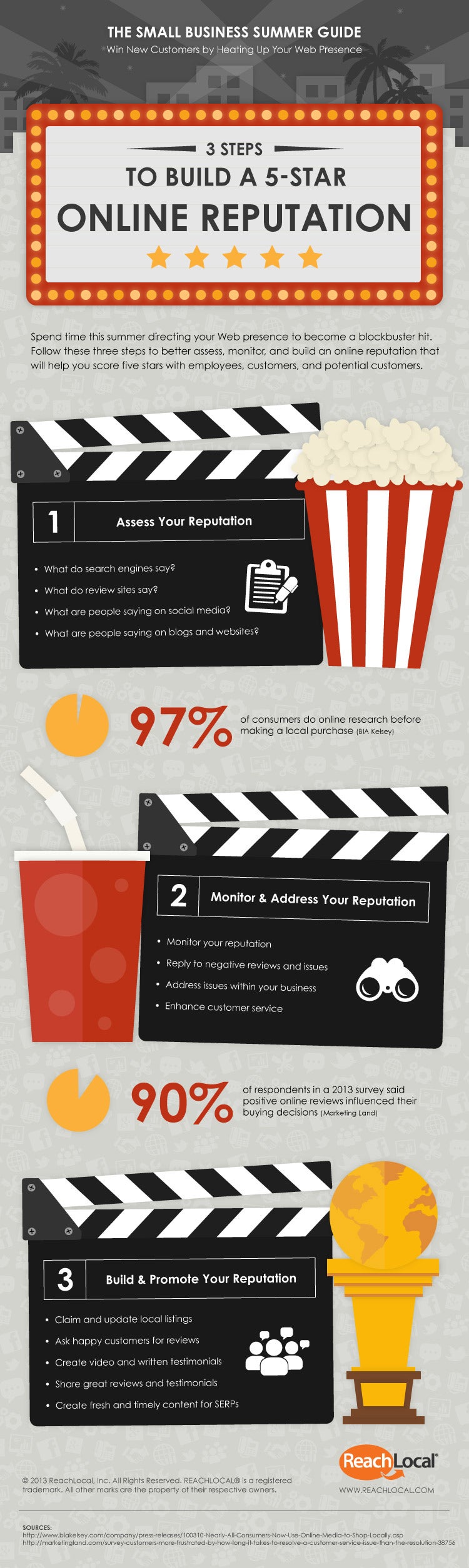
Potential customers (and employers for that matter) don't just want to see that you are active online. They want to see that you are contributing something and are part of an online community. Ninety-percent of those surveyed say online interaction plays a huge role in their buying decision. Is your brand making the right impression online? Here are three ways to kick it up a notch.

1. Assess your reputation. Find out what people on blogs, social media and other websites are saying about your brand.

2. Monitor and address your reputation. Use Google Alerts for easy monitoring of terms related to your brand. If you find someone saying something negative about your brand, practice good customer service and follow-up with them. If it's an issue that can be fixed, take sets within your business to do so. 

3. Build and promote your reputation. Collect reviews and testimonials from happy customers. Shares these comments via your network.

For more ideas about developing your brand online, sign up for our newsletter.

50 Ways to Energize Your Social Audience

Most social audiences aren't captured overnight. You have to invest time and care into building these online relationships. Breath new life into your network with these 50 tips.

  1. Inspire them.
  2. Connect with them in an authentic, human way.
  3. Entertain them.
  4. Educate them.
  5. Empower them.
  6. Listen more than you talk.
  7. Learn early on it’s not about you, it’s about them.
  8. Know them well. What keeps them up at night? What problems do they have that you can help solve? Prioritize your audiences and align your social media efforts to business goals and audience needs.
  9. Want their friendship and authentic relationship more than you want their follow, like, or visit to your blog.
  10. Don’t take their trust for granted. Just because they trusted you with their email address or connected with you on LinkedIn doesn’t mean you should take advantage of it and spam them.
  11. Leave a good first and last impression with every visit to your blog, website and social network profile.
  12. Respect their time, attention and presence in your social community.
  13. Never take their membership in your community or readership of your blog for granted.
  14. Don’t over burden them with requests to like, tweet, retweet and share.
  15. Make them feel emotion of any kind. Make them belly laugh or do the happy cry.
  16. Tell them stories that they can relate to.
  17. Communicate with them in words they speak and understand.
  18. Help build them. Help them build their knowledge, business, worth and brand.
  19. Help them solve problems.
  20. Help them be better.
  21. Help them do more with less and drive efficiencies.
  22. Offer them something unique. Give them something more than they can get with a simple, expected Google search. Serve them up the unexpected, not status quo!
  23. Help them connect with others.
  24. Help them obtain new business and referrals.
  25. Encourage them to share their best stuff.
  26. Help them transform their life or business.
  27. Help them break an old and bad habit.
  28. Help them start new healthy habits.
  29. Help them find new resources offered by others.
  30. Help them learn new words, phrases and their meaning.
  31. Help them better communicate with their peers.
  32. Make them feel cared for.
  33. Help them feel part of your community.
  34. Treat them as a human being, not a number of your fan base.
  35. Help them obtain visibility for their work, content or business.
  36. Invite them to join your communities. They may not know they exist.
  37. Host an online or offline event to bring community members together and build deeper relationships.
  38. Pick up the phone and have a real conversation.
  39. Simply be their sunshine on a rainy day.
  40. Respond in a timely manner when they ask you a question.
  41. Give credit where credit is due. If a community member inspires a blog post or other content, give them full credit and public acknowledgement.
  42. Leave your own turf sometimes. Visit other people’s blogs, social communities etc.
  43. Give them something compelling to remember you by.
  44. Share the social love. Visit their blog or networks where they are sharing great content. If you like what you see, share it with your community.
  45. Don’t give social love with an expectation of return. Give to give, not give to get.
  46. Keep it real. There is only one you so be that person or that brand, period.
  47. Acknowledge your community is made up of human beings. Humans are not perfect and make mistakes. Allow for mistakes and deal with them as a human.
  48. Post community guidelines and communicate openly why you have such guidelines.
  49. Empower people within your community to become organic leaders. Encourage them to teach one another and help each other grow.
  50. Provide them the most relevant, valuable content and conversation possible. Create a content editorial calendar to help you plan, organize and deliver the most engaging and helpful content you can offer.

Get more tips at the original post here.